Extended form

Thursday, September 1, 2016

Monday, August 29, 2016
Wednesday, August 24, 2016


Wednesday, August 10, 2016


Wednesday, July 20, 2016
5,000 Year Old Chinese Beer Recipe from Pottery
"Archaeologists discovered ancient beer-making tools in underground rooms, that were built somewhere between 3400 and 2900 B.C. The discovery was made at a dig site in the Central Plain of China and contained pots, funnels and specially designed jugs. Objects suggest they were probably used for brewing, filtration and storage of beer."
read here
read here
Sunday, June 19, 2016
Tuesday, March 15, 2016
Reflections: Mend
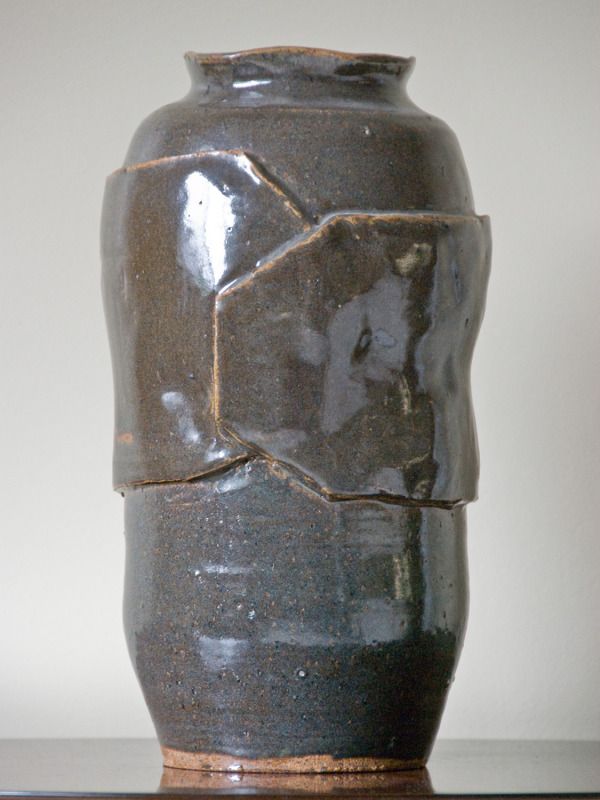
This piece was made in high school, 2001 or so. It was one of my earlier attempts at a stacked pot: throw two separate pieces, let them dry to leather-hard, then stack one top of the other. The two vases were probably around 10-12 inches tall. So the piece is pretty tall overall.
Like many early attempts at a particular technique, there is always a fuck-up. In this case, the top of the bottom half didn't align with the bottom of the top half. There was no sense of continuity between the two. The ceramics teacher suggested I put a slab over the middle and smooth it over.
But...as you can see... I got a little lazy and just put the slab on and didn't smooth it over. I kind of liked it this way (although in retrospect, not so much). I liked how it looked like a band-aid trying to mend the division and its precarious connection. The metaphors are all there - hugs, hands; much to do about holding together.
Later on when I put the piece in some show, my mom said that we should name it Korea because it would be an analogy for unification and mending the bond between the two countries. I don't remember if that's what I named the piece. But it goes beyond Korea and I hoped it would resonate on various levels of being and putting things back on the mend.
Tuesday, October 13, 2015
Saturday, October 3, 2015


Friday, September 25, 2015
Tuesday, September 15, 2015
3,000 Year Old piece of pottery in Papua New Guinea
"A piece of red, glossy pottery found in the rugged highlands of Papua
New Guinea has been shown to be the oldest-known pottery in New Guinea.
Tim Denham of Australian National University, working with researchers
from Otago University, obtained precise dates for the pottery as part of
a study to learn more about how the technology spread throughout the
Pacific. People who lived on the coast of Papua New Guinea would have
had contact with seafaring, pottery-making cultures such as the Lapita
people. “It’s an example of how technology spread among cultures. Some
pottery must have soon found its way into the highlands, which inspired
the highlanders to try making it themselves,” Denham said in a press release.
“And it shows human history is not always a smooth progression—later on
pottery making was abandoned across most of the highlands of New
Guinea. No one knows when or why,” he said. To read about smoked mummies
in Papua New Guinea, go to the current issue's "World Roundup."
source
source
Tuesday, September 8, 2015
Recreating Booze from Ancient Pottery
"Resurrecting ancient beers and wines is a subtle alchemy, but Patrick McGovern knows all the tricks. He directs
the Biomolecular Archaeology Project for Cuisine, Fermented Beverages,
and Health at the University of Pennsylvania Museum. Many of his ancient
brews are sold by Dogfish Head brewery in Delaware.
How did you start making ancient drinks?
One of the first we made was the Midas beverage, based on residues in bronze vessels recovered from the Midas tomb in Turkey, which dates from 700 B.C. These pointed to an unusual drink combining wine, barley beer, and mead. There were also food remains in the tomb that suggested a barbecued lamb or goat stew with lentils and spices. We tried to recreate the funerary feast as a way of bringing the past to life.
One of the first we made was the Midas beverage, based on residues in bronze vessels recovered from the Midas tomb in Turkey, which dates from 700 B.C. These pointed to an unusual drink combining wine, barley beer, and mead. There were also food remains in the tomb that suggested a barbecued lamb or goat stew with lentils and spices. We tried to recreate the funerary feast as a way of bringing the past to life.
How do you go about recreating a drink?
People give me either samples of pottery or residues from ancient vessels possibly used for making, storing, or drinking a fermented beverage. I identify the markers of specific natural products: Tartaric acid is a fingerprint compound for grapes in the Middle East, for example, while calcium oxalate points to the presence of barley beer.
People give me either samples of pottery or residues from ancient vessels possibly used for making, storing, or drinking a fermented beverage. I identify the markers of specific natural products: Tartaric acid is a fingerprint compound for grapes in the Middle East, for example, while calcium oxalate points to the presence of barley beer.
What did the Midas beverage taste like?
We knew the three basic components—grapes, barley, and honey—but we didn’t know what the bittering agent was. It couldn’t be hops, as they only became available in Europe around 700, so we looked at the eastern Mediterranean spices that would have been available: saffron, cardamom, bitter vetch, cumin. In a competition among microbreweries to recreate the beverage, Delaware-based Dogfish Head used the best-quality saffron as their bittering agent, as well as Greek honey made from thyme blossom. Their winning beverage was on the sweet side, but the saffron gave it aromatic properties."
source
We knew the three basic components—grapes, barley, and honey—but we didn’t know what the bittering agent was. It couldn’t be hops, as they only became available in Europe around 700, so we looked at the eastern Mediterranean spices that would have been available: saffron, cardamom, bitter vetch, cumin. In a competition among microbreweries to recreate the beverage, Delaware-based Dogfish Head used the best-quality saffron as their bittering agent, as well as Greek honey made from thyme blossom. Their winning beverage was on the sweet side, but the saffron gave it aromatic properties."
source
Subscribe to:
Posts (Atom)