

Showing posts with label Bosco. Show all posts
Showing posts with label Bosco. Show all posts
Monday, November 14, 2016

Sunday, October 30, 2016


Wednesday, August 24, 2016


Wednesday, August 10, 2016


Tuesday, March 15, 2016
Reflections: Mend
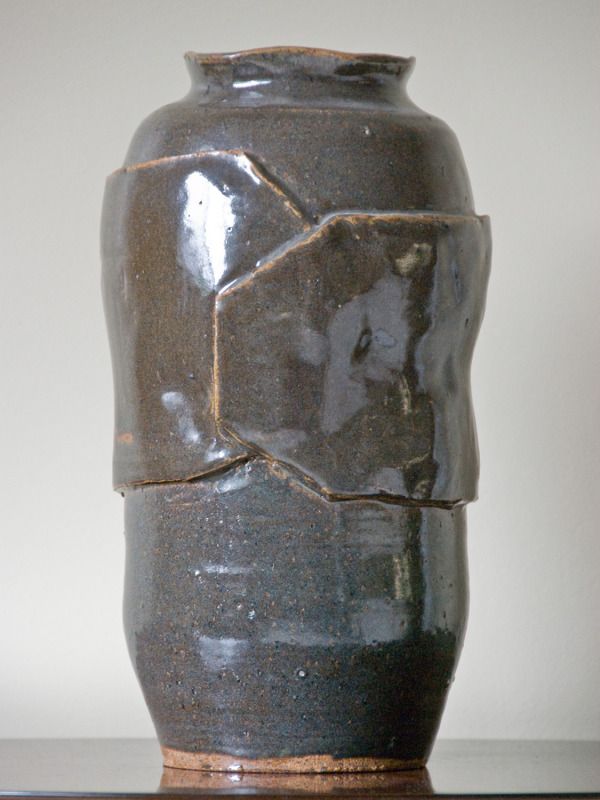
This piece was made in high school, 2001 or so. It was one of my earlier attempts at a stacked pot: throw two separate pieces, let them dry to leather-hard, then stack one top of the other. The two vases were probably around 10-12 inches tall. So the piece is pretty tall overall.
Like many early attempts at a particular technique, there is always a fuck-up. In this case, the top of the bottom half didn't align with the bottom of the top half. There was no sense of continuity between the two. The ceramics teacher suggested I put a slab over the middle and smooth it over.
But...as you can see... I got a little lazy and just put the slab on and didn't smooth it over. I kind of liked it this way (although in retrospect, not so much). I liked how it looked like a band-aid trying to mend the division and its precarious connection. The metaphors are all there - hugs, hands; much to do about holding together.
Later on when I put the piece in some show, my mom said that we should name it Korea because it would be an analogy for unification and mending the bond between the two countries. I don't remember if that's what I named the piece. But it goes beyond Korea and I hoped it would resonate on various levels of being and putting things back on the mend.
Friday, June 12, 2015
Reflections: From Fiction to Reality

This piece came about during a phase when I grew a bit tired of throwing; sometimes you just have to get off the wheel and do other stuff. So I began making heads, masks, and experimented with facial expressions - mostly smiling faces. One of which you can see on the side of this blog.
So I made this face - drawing inspiration from the Joker:

and the comedy-tragedy masks:

At first I thought about replicating a line by Ella Wheeler Wilcox from her poem 'Solitude':
Laugh, and the world laughs with you;
Weep, and you weep alone;
For the sad old earth must borrow its mirth,
But has trouble enough of its own.
Sing, and the hills will answer;
Sigh, it is lost on the air;
The echoes bound to a joyful sound,
But shrink from voicing care.
Rejoice, and men will seek you;
Grieve, and they turn and go;
They want full measure of all your pleasure,
But they do not need your woe.
Be glad, and your friends are many;
Be sad, and you lose them all,—
There are none to decline your nectared wine,
But alone you must drink life’s gall.
Feast, and your halls are crowded;
Fast, and the world goes by.
Succeed and give, and it helps you live,
But no man can help you die.
There is room in the halls of pleasure
For a large and lordly train,
But one by one we must all file on
Through the narrow aisles of pain.
It's those first couple lines. I've heard them before but never had the impetus to go look it up until it was referenced in the Korean film, 'Old Boy':

Like the Counte of Monte Cristo, the main chracter is locked away without knowing his crime. But in this prison-apartment, there is this picture with the first line from Ella Wilcox's poem (in korean, of course:

The painting is by James Ensor entitled, 'Man of Sorrows'. And one of my first ideas, along with the Joker, was to recreate something like this and use the same line: "Laugh and the whole world laughs with you. Weep, and you weep alone." I liked it but... it was almost a bit too angsty and had a strong existentialist overtone - not that that would be bad or unappealing but it invoked a certain mood from high school and some sculptural work I did then. I wanted to go in a different direction, something that reflected my own thoughts and feelings at the time.
Coincidentally, I watched the anime movie Paprika. Just randomly out of the blue, I thought I'd watch it. If you don't know:
And in this movie, is the line: "From fiction to reality." This was it. I thought it was great as it not only evoked dystopian and utopian imaginations but it also reflected the process of manifesting one's imagination, one's fiction, into a form of reality. From fiction to reality seemed to capture the process of becoming within the creative process. Translating my imagination. It was vague enough to evoke a range of meaning from different perspectives and the smiling face could provide another layer of construction. So I decided to use the phrase and go ahead with making a wall piece.
I was using a clay body called 'Dark Mountain' and had some scraps left over so I used a rolling pin to flatten it out and give it wood-like surface. I scored the bottom and attached the head.
It was my first time using this clay body so I wasn't quite sure how the glazes would turn out. So I decided to go with, what I was doing quite a bit at the time, simply staining the piece with red-iron oxide. Knowing that the clay was rich in iron and adding the stain, also rich in iron, I was told that it would give off a steel-blue-ish, gray-ish color. This was the final product:

When it first came out, I thought it was alright. Some of the things I took away was that while it looked really good laying on the surface of the table, when it hung on the wall the face was tilted a bit too much to the floor. I could have altered it so that it would look a bit more directly at the viewer. I thought th clay body came out really well. The rich brown and the texture was great. Some mixed feelings about the red iron oxide. At any rate, it would be fun to do a series of similar wall pieces and kind of play around with the combinations of face, phrase, font, clay bodies, and different techniques of arrangement. One thing is for sure: just because it looks ok flat on the table, doesn't mean that it will look good on the wall.
At any rate, this was a fun piece, I enjoyed making it.
Thursday, June 11, 2015
Reflections: Snot from the fire gods
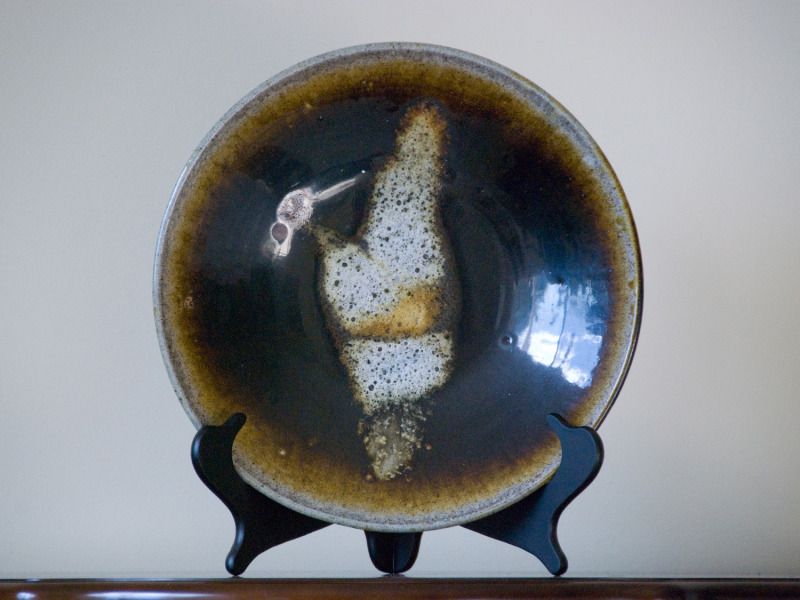
The previous post reminded me of this piece. I think it was a saggar firing and, at the moment, I can't remember what I even glazed them in... but there are two glazes at work here (the lip of the bowl was dipped in something else, which gives it the aesthetic it has above). It's a pretty big bowl, maybe about 15 inches in diameter. But the reason why I like this piece, and was reminded of it from the previous post, is that the result was very much unexpected - particularly that effect in the middle.
When the piece came out of the firing, the ceramics teacher looked at me and said that I got some "kiln snot." I thought the phrase was amusing: "kiln snot." My bowl was a kleenex and the fire gods decided to blow their nose! Sometimes they bless you with something nice and sometimes they shit on it. It's part of the fun. The uncertainty. The unexpected. We try to control for the effects, adjusting where we place it in the kiln, trying to decrease or increase oxygen flow, manage runny glazes, use wax, control how long we dip the glaze - depending on our understanding of it, use electric or gas kilns, and do the best we can. But there is always the possibility for something weird and fun. I think it's best to embrace the uncertainty and the unknown as we perfect our craft and techniques.
While there is, at least for non-production potters (and this isn't to say that production potters don't put their own stamp on their work but part of their training is to make every piece the same - a mechanization of embodied technique), a deep personalization with the process of creating a piece and when you have something you really like, it makes the glazing process that much more difficult fully knowing that the fire gods may not bless it with the desired outcome. And when the work comes out of the fire, sometimes you love it that much more or learn to detach yourself from it, take a couple lessons for the future, and disgard it. I remember my old ceramics teacher from high school telling me that out of every 10 pieces he throws, he might like 1 or 2. I never understood this until later on and it's one of those things that I've remembered. And indeed, if it weren't for my mother, even as an amateur and hobbyist, I probably would have trashed most of my pieces or recycled them into something else (For the record, I would have kept this piece - never had the fire gods blow their nose before).
Saturday, May 23, 2015
Reflections: Teacups
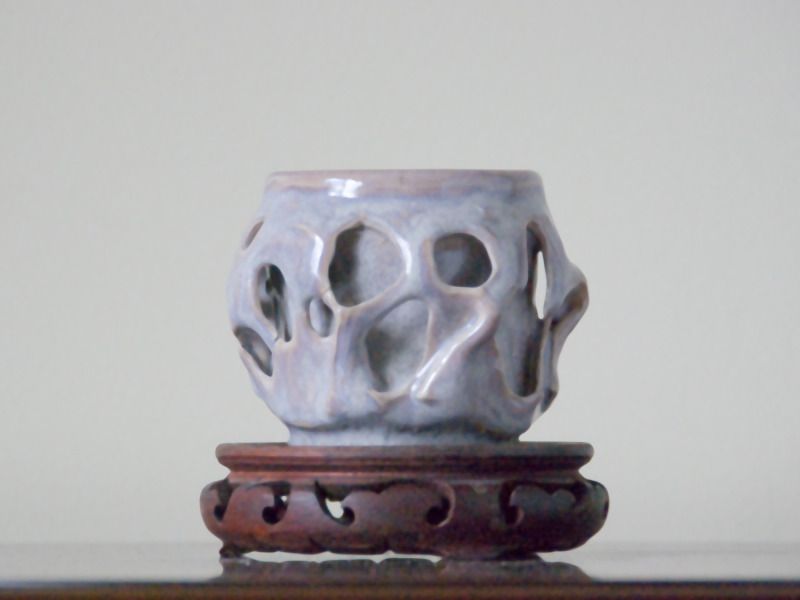
Can't remember exactly when I made these but sometime between 2009-2011. The idea came while drinking tea with my parents. They had a tea cup with two walls such that the outerwall and the innerwall was separated by a gap. The effect was simple: insulation; when you held a hot cup of tea, or whatever hot beverage, your hands wouldn't get hot. Separating the innerwall from the outerwall allowed you to hold the cup regardless of the heat. I thought this was great. The piece that my parents had was pretty remarkable, something that I could probably never duplicate, and had a hunch that it was factory made. I was intrigued nonetheless and wondered whether I could replicate a similar effect. You can see them here. Some turned out alright, aesthetically, others not so much; they all achieved the desired function of insulating the heat.
So with the idea of trying to reproduce a certain function, and a particular piece as motivation, I abandoned the idea of trying to replicate its aesthetic or style, which allowed me to be creative in achieving the desired effect. I remember sitting down on the wheel and thinking about how I was going to do this double layered tea cup. I could throw one cup and then use a slab over it, carve it up and smooth the lip, which seemed like a bit more work than desirable. Yup, I'm lazy.
The next idea was to throw a very tall and thin cup and then fold it over in the middle creating two walls with a layer of air in between. I could then smooth the lip and the foot over and in its leatherhard stage I could carve the outer wall to make it lighter and accentuate the gap. I figured this was as good a strategy as any.
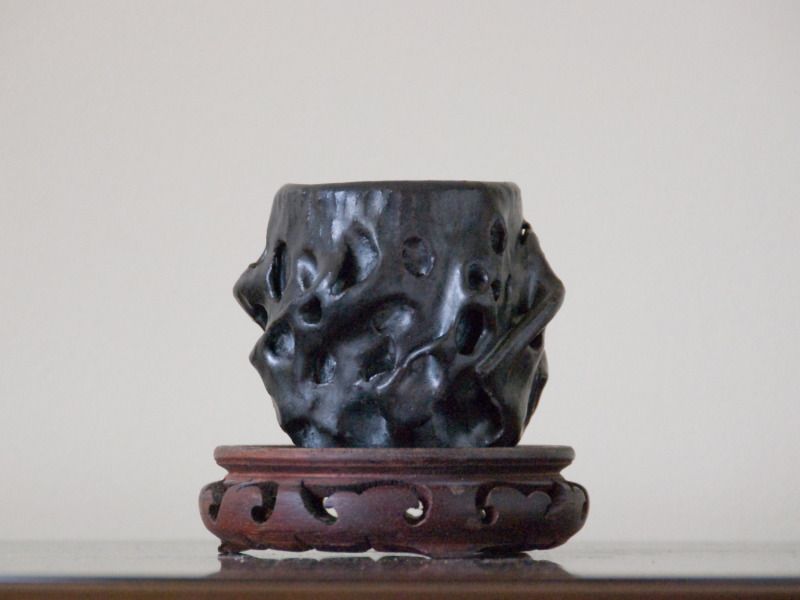
I made the first couple with relative success. The process wasn't difficult but it soon became a process of getting the aesthetics to a point where I was satisfied with the outcome. And to be sure, I'd probably throw away most of them. As I began carving out the outerwall, I really started to like the cave-like effect or even something like a termite mound:

So I tried to mimic the colours:
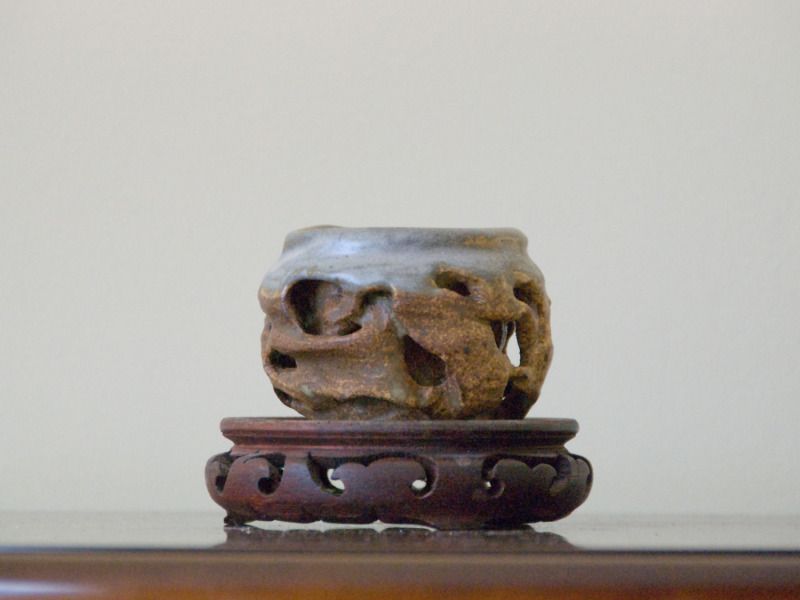
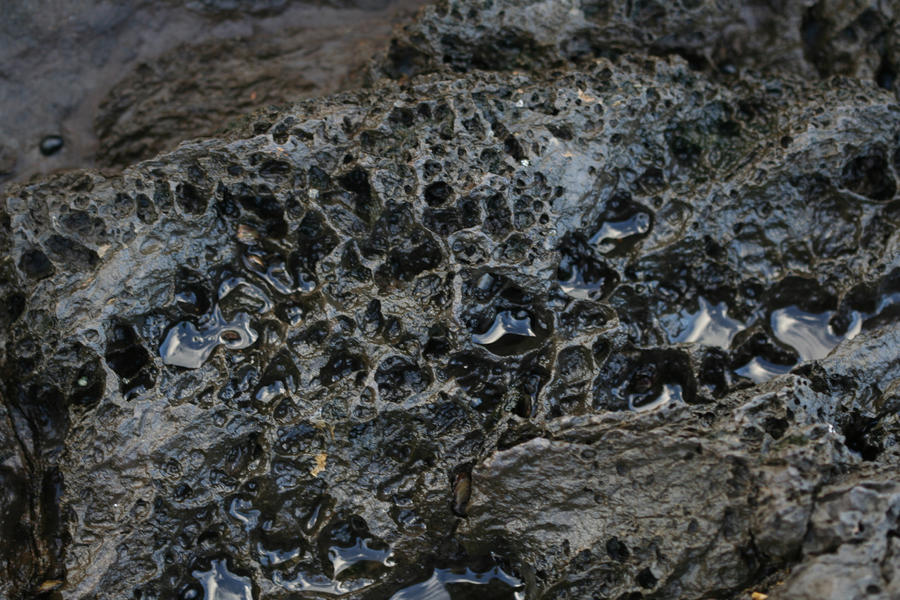
It even reminded me of lava rock:
So I tried to mimic that as well:
There was also a point when I got really sick of the carving and making sure there was a layer of air between the first wall and the second. So I decided not to do any carving:
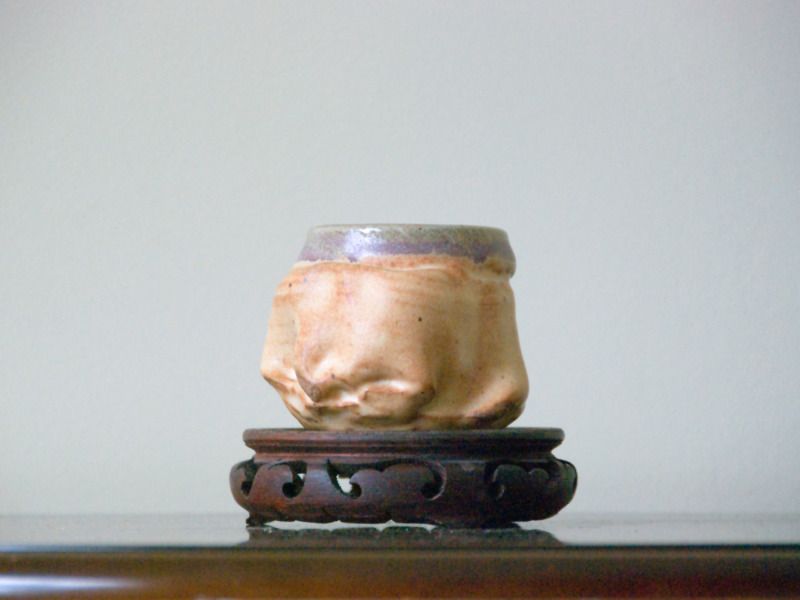
As you can see, there is a pocket of air bulging out the side of this piece. For the one's above, prior to firing it in the bisque, I would have carved that pocket out. If you click the link above, you can see pieces where the outerwall didn't quite make the separation I would have wanted.
At any rate, the inspiration of these pieces began with something factory-made in my parents' cupboard and progressed into mimicking something in nature. I think the piece - from this series of teacups - I liked the most is probably the one at the top of this post, glazed in purple. The rest I don't care so much about and, if I was a professional potter trying to perfect my craft, wouldn't think twice about tossing them.
Friday, March 27, 2015
Reflections: Caterpillar

This is a much more recent piece, 2010 or so, and unlike the previous reflection on the multi-spouted slab, this was much more deliberate and intentional - although it didn't realize in the way I envisioned it (which tends to be the case). The title came after completion, which I'll get to in a minute, but the idea of throwing a large bottle (turned out to be... 14? 15? inches) and then cutting it into segments and stacking them in a stagger formation was an idea in my sketchbook. I suppose this was a test piece and actually trying to make it provided some insight into how I might go about it the next time.
After I threw the piece, and prior to cutting it into segments, I put a groove into the body with a wooden knife; cyclically going up and down. I then let it dry a bit. In retrospect, I should have let it dry a bit longer. I think I was a bit eager to move the project along but a bit more patience would have served the piece better in the long run. When I cut off the sections, they were still a bit wet which ultimately gave it a droopy look. And again, I could have let the pieces dry a bit longer after cutting out the segments but at the same time I didn't want them to dry out entirely. A nice leather-hard state of the clay would have been ideal. Another thing that struck me was that I should have thrown the walls a bit thicker. As you can see in the picture to the far right, the walls are a good size for a bottle this big but for the purposes I had in mind thicker walls would probably have provided a bit more stability and facilitated the stacking process. There simply wasn't enough contact between the pieces to firmly connect the segments.


Nonetheless, I made due with what I could. I was determined to make it work somehow. Another thing that became strikingly obvious and something I didn't think of in my sketchbook was the effect of gravity! Haha duh, right? What this means is that there was a series of balancing acts that had to go into re-assembling the sections into a stagger and how to position each piece became it's own little struggle. It got sloppy and assembling it wasn't as easy as I thought it might be. Cracks starting appearing because one section wasn't bearing the weight - too wet or the walls were too thin. This prompted the use of more clay on the sides and a viscuous slurry to give the smearing look that you can see in each of the pictures above. I liked the smear. Improvised ideas become "artistic" when it amends structural inadequacies.
I liked the idea of smearing clay and giving a certain "organic" texture to the piece. Something I'm likely to explore further when I get another chance. But the process of actually building this piece not only yielded a fun stylistic idea but it also gave more insight into the balance of patience and construction into making something like this work. How this piece actually turned out looks dramatically different from what's in my sketchbook. On one hand, there is the attempt to faithfully recreate the piece: imagination to reality. On the other hand, there is a beauty and appreciation in the messiness that comes from the actual construction. Perfectionism is abandoned when unforeseen practical constraints present themselves. In future attempts at another staggered peice, this will be the struggle: faithful recreation and improvised amendments. The vision and the adjustments. In many ways, it is a failure in manifesting the vision. But in its failure it came to yield something else and the act of creation became meaningful in other ways besides the ideal.
The title 'caterpillar' was, in one sense, describing a certain motion that the piece in some sense tries to capture. But metaphorically, the caterpillar repreents a dynamic phase in the ontological becoming of a butterfly or moth and connotes a process of becoming carrying a certain preoccupied baggage with perfection.
(*the first picture is why you have someone who knows how to work a camera take pictures of your piece. The latter three pictures, as you can see, are evidence of my shotty camera work)
Subscribe to:
Posts (Atom)